Sunday, 28 February 2021

February statistics


Games: 5
White: 4
Black: 1

Won: 3
Drawn: 1
Lost: 1

Shortest game: 13 moves (won)
Longest game: 66 moves (drawn)

Rating at the start of the month: 1695
Rating at the end of the month: 1712

Minimum/maximum rating: 1695/1714 

Friday, 26 February 2021

Blunders galore - and yet a 50/50 score

Pepealfonso2 (Spain) - Hennie Schaper
Spanish Four Knights Game

1. e4 Nf6 2. Nc3 e5 3. Nf3 Nc6 4. Bb5 Bb4 5. 0-0 0-0 6. d3 d6 7. Nd5 Nxd5 8. exd5 Ne7 9. a3 Ba5 10. c4 h6 11. h3 c6 12. dxc6 bxc6 13. Ba4 Bb6 14. Bc2 Nf5 15. b4 Nd4 16. Nxd4 Bxd4 17. Ra2 a5 18. bxa5 Rxa5 19. a4 Qh4 20. Qf3 c5 21. Be3 Be6 22. Bxd4 Qxd4 23. Qe4


The first 22 moves were pretty straightforward. White rejected the Alekhine, and a symmetric four knights game emerged. Once the symmetry was broken, both sides played normal moves to enter the middle game. White's 23d move is a blunder, but I did not see it to my shame. With Qxe4 dxe4 Bxc4 black has a winning game. Instead....

23. ... Rfa8 24. Qxd4 exd4 25. f4 g6 26. Kf2 Kg7 27. Kf3 d5 28. Bb3 dxc4 29. Bxc4 Bxc4 30. dxc4 Rxa4 31 Rxa4 Rxa4


Oblivious of the blunder made earlier, black has made progress. An extra pawn (passed and protected!) and active rook should be enough to win, even though rook end games are notoriously drawish.

32. Rc1 Kf6 33. Ke4 Ke6 34. Rc2


This time I did see the right move - but only after I had played the wrong one. With Ra3 black puts white in a very messy situation: the sudden mate threat means white has to sacrifice the f-pawn. I was really kicking myself for playing:

34. ... f5+ 35. Kf3 Ra3+ 36. Kf2


In spite of the blunders black still has a comfortable end game. A move like Kd7 would probably eventually result in a win. I thought I could do it easier: exchange rooks, force the white king to the queen side and break through with the king on the kingside to promote one of the pawns. Well, that worked, but not as well as I thought it would. So my next move goes down as yet another blunder:

36. ... Rc3 37. Rxc3 dxc3 38. Ke2 g5 39. Kd3 gxf4 40. Kxc3 Ke5 41. Kd3 f3 42. gxf3 Kf4 43. Ke2 Kg3 44. Ke3 Kxh3 45. Kf4 h5 46. Kxf5 h4 47. f4 Kg3 48. Ke5 h3 49. f5 h2 50. f6 h1=Q 


This is basically what I had envisaged when I played 36. ... Rc3. The problem though is that black cannot easily prevent that the white pawn will also promote, given the great position of the white king. Not easily, but it is possible. After f7 I should have played Qh6! Alas....

51. f7 Qe1+ 52. Kf6 Qc3+ 53. Ke7 Qe5+ 54. Kd7 Qf5+ 55. Ke7 Qe4+ 56. Kd7 Qxc4 57. f8=Q 


Seeing no realistic way to stop the promotion I decided to go into the KQ vs KQp ending. However, I did not find the right strategy from now on. Once the white queen starts checking, the black king should have gone to the king side to allow the black queen to get in-between with check on the white king. Instead I went for the queen side (to protect the pawn in some variations) but that was doomed to end in a draw.

57. ... Qd5+ 58. Kc7 c4 59. Qg7+ Kf3 60. Qc3+ Kf4 61. Qf1+ Ke4 (Kf5 was probably winning) 62. Qh1+ Kd4 63. Qg1+ Kc3 64. Qa1+ Kb4 (Kc2 would give black another chance to go for the right kingside strategy) 65. Qb2+ Ka4 (I had planned Kc5 - which fails to a mate in one....) 66. Qa2+ Kb4 with a draw offer that white accepted. 1/2-1/2

Thursday, 18 February 2021

Fine: I'll take nine

Hennie Schaper - AR111222 (India)
Ruy Lopez

1. e4 e5 2. Nf3 Nc6 3. Bb5 Bc5 4. 0-0 d6 5. c3 Bd7 6. d4 exd4 7. cxd4 Bb6 8. Nc3 Nge7 9. Be3 0-0


So far so good, a pretty normal set of opening moves in one of the many sub-variations of the Ruy Lopez. I was contemplating retreating my bishop to d3 (preferably after a6) and launch a kingside attack. For that plan, I did not like Nb4 after Bd3, so I played 10. a3. The computer in after-game analysis does not particularly like that, clearly preferring 10. h3.

10. a3 Bg4 11. Ne2 Bxf3 12. gxf3 d5 13. Kh1


I like this kind of position. White has opened up a file to the black king, and has the bishops pair - imo ample compensation for the pawn structure. While black was thinking about his next move, he clicked a draw proposal. I was not intending to accept it, and anyway I wanted to see his move first. To my surprise about half a minute later he resigned. One can only assume that he had to abandon the game for personal reasons. Too bad of course - but nine rating points in the bag. 

Black resigns. 1-0.

Sunday, 7 February 2021

C'est la vie

Hennie Schaper - Guadamjuzo (Nicaragua)
French Defence

1. e4 e6 2. d3 d4 3. e5 (I used to play the advance variation against the French - probably going to change after this game) c5 4. c3 Nc6 5. Nc3 Qb6 6. Qb3 Qxb3 7. axb3 cxd4 8. cxd4 Bb4+ 9. Nc3 Nge7 10. Bd2 0-0 11. Bd3 a6 12. 0-0 Bd7 13. Rfd1 b5 14. Be3 Rfc8 15. Ne2 Na5


So far, things have gone pretty much according to plan from both sides in this opening. White has compensation for the double pawn in the open lines and better weak bishop. For some reason, I did not even consider the only good move here (Nc1 with a roughly equal position), but sacrificed a pawn for no good reason.

16. Rdc1 Nxb3 17. Rxc8+ Nxc8 18. Rb1 Nb6 19. Bc2 Na5 20. Bd2 Bxd2 21. Nxd2 Nac4 22. Nxc4


It's black's turn to make a mistake now. After dxc4 I don't think white has any play against the black pawn steamroller.

22. ... Nxc4 23. Nc1 a5 24. Nb3 a4 25. Nc5 Be8 26. f4 g6 27. Bd3 Kg8 28. Kf2 Ke7 29. Ke2 Bc6 30. g4 f5 31. g5 Rh8


The material difference is still only one pawn, but to say I had little confidence in white's chances would have been an understatement. My opponent, rated 50 points higher than me, has played well so far, and on top of that he had 20 minutes left and I had 10. My next move is another mistake (I put all my hopes on a good knight versus bad bishop ending that was never going to happen anyway). Best would have been Kf2 - even then, white should lose.

32. Bxc4 dxc4 33. Kd2 h6 34. h4 hxg5 35. hxg5 Rh2+ 36. Ke3 b4 37. Na6 (better d5) Rh3+ 38. Kd2 Be4 39. Re1 c3+ 40. bxc3 bxc3+ 41. Kc1 a3 42. Rb4 Rh2 0-1

The position is completely lost and had been for some moves already. A pity to lose a game after nine games without a loss, but c'est la vie.

Tuesday, 2 February 2021

Warts and all.....

Hennie Schaper - SergeiSomov (Russia)
Philidor Defence

1. e4 e5 2. Nf3 d6 3. Bc4 a6 4. 0-0 Bg4 5. h3 Bh5 6. d4 exd4 7. Qd3 Bxf3 8. Qxf3 Nf6


It is difficult to imagine but black's move is a blunder. I was focusing on exploiting the weakness on b7, but missed the simplest and most effective way to do so. After 9. Qb3 threatening f7 and b7 white has a winning position. After my move things are far from clear.

9. e5 dxe5 10. Qxb7 Nbd7 11. Qb3 Qe7 12. Bd2 (c3 is stronger, but I felt I needed coverage of the e1 square in some variations) Nb6 13. Re1 Nxc4 14. Qxc4 Qd6 15. Na3 (playing it safe; better is Rxe5, but I was not 100% sure) Be7


Black's last move is a mistake (0-0-0 was required). I had to play Rxe5 here (black cannot take because of Qc6). Instead I played the tempting but wrong Bb4.

16. Bb4 Qxb4 (the losing move - after c5 instead black has an excellent game) 17. Qc6+ Kf8 18. Qxa8 Re8 19. Rxe5 f6 20. Re2 Qxb2


I had seen that - it is only a temporary knight sacrifice.

21. Rae1 Qxa3 22. Rxe7 Qxe7 23. Rxe7 Kxe7 24. Qe4+


White has a completely won position. Black will lose more pawns, and cannot get his rook and knight to work together. Black might as well have resigned here, because I had plenty of time left. The game concluded:

24. ... Kf7 25. Qxd4 Kg6 26. Qd3+ Kf7 27. Qxa6 Nd6 28. Qc6 Kg6 29. Qxc7 Nf7 30. a4 Ne5 31. a5 Rf8 32. a6 Rf7 33. Qc5 Nd7 34. Qd4 Ne5 35. a7 Rf8 36. Qe4+ Kg5 37. a8=Q 1-0

In spite of the inaccuracies, a pleasing win against an opponent rated 50 points higher than me. 

Monday, 1 February 2021

Undeserved but won nonetheless

Hennie Schaper - Takamune (Japan)
Philidor Defence

1. e4 e5 2. Nf3 d6 3. Bc4 h6 4. d4 exd4 5. Nxd4 c6 6. 0-0 g6 7. Re1 Bg7 8. c3 Ne7 9. Bf4 0-0 10. Qd2 Kh7 11. Qe3 Nd7


Tempting is of course to snatch up the pawn at d6, but after Nb6 white has no choice but to enter the exchange series Bxe7 Nxc4 Bxd8 Nxe3 which gives black a comfortable equal game.

12. Nd2 Ne5 13. Bxe5 fxe5 14. N4f3 Qc7 15. Nf1 Bg4 16. Ng3 b6 17. h3 Bxf3 18. Qxf3 f5


Thematic, but white is a little bit better after this error. Black should have continued his passive play with a move like Ng8 - white is comfortable but has no clear longer term benefits.

19. exf5 Nxf5 20. Nxf5 (better would have been Bd3) Rxf5 21. Qe3 Raf8 22. Re2 Rf4 23. Bb3 


Black's attack on f2 is theoretically without chance (in practice though.....). White has the better pawn structure and good play against black's isolated pawn. Black would have done better to abandon the attack on the f-file for the moment and play Rd8. With his queen move, he gives white control over the d5 file.

23. ... Qd6 24. Rad1 Qe7 25. Red2 Qg5 


White has a great position, especially if he can put a rook on the 7th rank. Like now. However, I wanted to cover the pawn at f2 before doing that, setting up all kind of complications I had not foreseen. The main problem is that after a Rxf2 in the near future, white cannot play Qxg5 because of Rxf1+. After my blunder in this position, the white advantage is gone.

26. Rf1 e4 (black returns the favour. After Rxf2 white has to give the queen for the two rooks with an equal game) 27. Bc2 (only after I made this move did I see the Rxf2 line while black was thinking about his reply; Rfd1 would still lead to an advantage) Qe5 (but black also does not see it. Even now Rxf2 leads to a position that is probably won for black). 28. Rd4 (Re1 is probably better) Re8 29. Re1


White is better now, with the pawn on e4 about to drop, and pieces to be exchanged. The main lifeline for black in any endgame is the bishops of opposite colour. Black blunders now with Qc5, allowing white to play Qxf4 and white comes up in a winning position after all responses. I did not see it, but went for the elimination. 

29. ... Qc5 30. Rxe4 Qxe3 31. R1xe3 Rfxe4 32. Rxe4 Rxe4 33. Bxe4


Well, there's the endgame. White is a pawn up, and can bring the king into play quicker, but black has fair drawing chances. However, time control starts to play a role as well. The white position is easier to play, and black already had 3 minutes less left than white. It proved fatal in the end.

33. ... c5 34. Kf1 h5 35. Ke2 Be5 36. g4 h4 37. Ke3 Kg7 38. f4 Bd6 39. f5 g5 40. Bc6 Kf6 41. Ke3 Bf4 42. b3 Bd2 43. c4 Bc3 (down to 2 minutes) 44. Kd5 Ke7 45. Bb5 and black stared the remaining one and a half minutes at the position without making a move: lost on time. 0-1.

Sunday, 31 January 2021

January statistics


Games: 13
White: 6
Black: 7

Won: 10
Drawn: 2
Lost: 1

Shortest game: 17 moves (won)
Longest game: 105 moves (drawn)

Rating at the start of the month: 1631
Rating at the end of the month: 1695
Minimum/maximum rating: 1631/1695

Friday, 29 January 2021

Short, sweet and simple

String Quartets (Brazil) - Hennie Schaper
King's Indian Defence

1. c4 Nf6 2. g3 g6 3. Bg2 Bg7 4. e4 d6 5. d4 0-0 6. Nc3 c6 7. Nge2 e5 8. 0-0 Nbd7 9. Re1 Re8 10. Bg5 h6


So far it has been a reasonably normal sequence of moves for this opening. White's next move is not a real mistake, but conceding the bishop's pair in a position that can be ripped open any time may not be the best idea either.

11. Bxf6 Nxf6 12. dxe5 dxe5 13. Qxd8 Rxd8 14. Rad1 Be6 15. b3 Kf8 16. f4


This is a real mistake though. Black's knight can now exploit the weakness of square e3. A move like Nc1 would have been better.

16. ... Ng4 17. Nc1 

Tempting but wrong. After Rxd8 black is a bit better but white still has plenty to play for.

17. ... exf4 18. gxf4 Bxc3


And black is a piece up with all kinds of additional threads. To my surprise white offered a draw, but before I could answer, he resigned. Later I found out that this was his first game on the site, so I ascribe it to hitting the wrong button. He was clearly no chess newbie given the solid opening play - and the start ranking of 1600 assigned by the site.

0-1.

Wednesday, 27 January 2021

The Seesaw Sea Snake

UmarXudayberdiyev (Uzbekistan) - Hennie Schaper
King's Indian Defence

1. c4 Nf6 2. d4 d6 3. h3 g6 4. e3 Bg7 5. Bd3 0-0 6. g4 e5 7. Nf3


White has played an unorthodox but fairly aggressive attack against the King's Indian. This move is marked as a mistake though in the post-game analysis. I did see the fork option with e4, but did not think black would come out better after g5. The computer disagrees, giving the line 8. ... exd3 9. gxf6 Qxf6 10. Nc3 Re8 11. e4 Nc6 as clearly better for black.

7. ... exd4 8. Nxd4 Re8 9. Ne2 Nc6 10. Bd2


Time for a blunder. Tempting but wrong to play Nxg4 with a small material gain (rook and two pawns for bishop and knight), but leaving white with far more play than necessary. Instead d5 would give black a very nice game.

10. ... Nxg4 11. hxg4 Bxb2 12. Nbc3 Nxa1 13. Qxa1 Ne5 14. Be4 Bxg4 15. Nf4


Time for another blunder. I should have consolidated with c6. Instead I forced white to give up the bishops pair, but the black knight is more useful than the white bishop in this position. The computer rates the position after my next move is roughly equal.

15. ... Nf3+ 16. Bxf3 Bxf3 17. Rh2 Qf6 18. Nfe2 Bxe2 19. Kxe2 Re7


Blunder number three. I did realize that this puts Nd5 as a killing option in the position, but disregarded it because at the moment the knight is pinned because of the unprotected queen on a1. What I did not see is how easy white can unpin with a threat.

20. Qh1 h5 21. Nd5 

Now, after the most sensible move Qe6 white takes the rook and has about equal material with bishop versus three pawns, but all the play. I decided to mix things up - and white got greedy. 

21. ... Qg5 22. e4 Qg4+ 23. f3 Rxe4+ 24. Be3 (the simple Kd1 wins) Rxe3+ 25. Nxe3 Qe6 26. Qg1 Re8


The gamble paid off - black has four pawns for the knight, a good pawn structure and active play.

27. Kd2 Kf8 (better would have been Qe5) 28. Re2 (better: Nd5) Qf6 29. Qb1 Qd4+ 30. Qd3


Time for blunder number four. Black needs to keep the queens on the board to better utilize the army of pawns. Qf4 and keeping on advancing the h-pawn is probably winning for black.

30. ... Qxd3 31. Kxd3 c6 32. Rb2 b6 33. a4 Kg7 34. Ra2 Re5 35. f4 Re7 36. a5 Kf6 37. abx6 axb6 38. Nc2


Blunder number five, and even worse, this is really a missed win. With Kf5 followed by Kxf4 (after e.g. Nd4+) white is losing. I did not see it. In the coming moves black cannot hold on to his extra pawns.

38. ... h4 39. Nd4 Rc7 40. Rh2 g5 41. fxg5+ Kxg5 42. Nf3+ Kg4 43. Nxh4 f5 44. Ng6 b5 45. Rc2 bxc4+ 46. Rxc4+ Kg5 47. Nf5 Rc8 48. Ne6+ Kf6 49. Nd4 d5 50. Rc5 f4 51. Nxc6+ Rc7 52. Kd4 Kg5 53. Rxd5+ Kg4 54. Ne5+ Kg3 55. Ke4 Ra7 56. Rd3+ Kf2 57. Kxf4
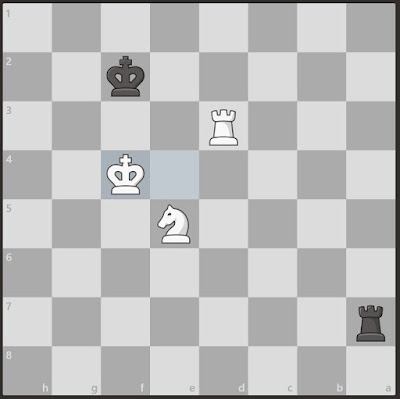

This is a drawn end game provided black plays it right (keep the king from the rims, and do not fall for knight forks or rook skewers). However, I had less than 5 minutes left and white had 11 minutes. I can't blame him for trying. I will not list the rest of the moves - white continued to probe, black did not blunder again, and on move 81 white actually lost the knight by carelessness. However, at that point white still had six minutes on the clock and I was down to two and a half. Probably the KR versus KR end game would be considered as a win for white when time runs out for black (black can be stupid and lose this), so white kept playing - but I did not blunder any more. At move 105 (in Dutch a chess game of over 100 moves is called a zeeslang, or sea serpent) I could claim a draw for three times the same position (with almost 2 minutes left). 1/2 - 1/2

In the end, given all my blunders I was happy with the draw against a higher rated opponent. I was particularly glad that I played the end games KRN-KR and KR-KR well at top speed.

Friday, 22 January 2021

Mindgames

ammar8013 (Iraq) - Hennie Schaper
Alekhine Defence

1. e4 Nf6 2. e5 Nd5 3. d4 d6 4. c4 Nb6 5. Nf3 Bg4 6. Nbd2 e6 7. Be2 Be7 8. h3 Bh5 9. Qb3


The first eight moves were pretty normal for the Alekhine. White now puts pressure on the queen side, in particular on the weak square b7. I have had similar positions in training matches against various levels of computer programmes at chess.com, and always struggled to equalize. Here I choose the wrong continuation: dxe5 was best. 

9. ... c5 10. exd6 Bxd6 11. dxc5 Bxc5 12. Ne4 Qc7 13. Nxc6 Qxc5 14. Be3 Qa5+ 15. Bd2 Qa4 16. Qd3 0-0 17. 0-0 Bg6 18. Qc3 Qc2 19. Qxc2 Bxc2 20. Rac1 Bg6 21. c5 Nd5 22. Ne5 Nc6 23. Nxg6 hxg6 24. a3 a5 25. Bb5


White has all the play: the bishops pair, the better pawn structure, queenside majority and more active pieces. But black has knights and sometimes opponents do not see where they are going. Like here.

25. ... Nd4 (please play Ba4, please play Ba4....) 26. Ba4 Ne2+

And suddenly black is an exchange up. There is still some work to do to cash in on the advantage though.

27. Kh1 Nxc1 28. Rxc1 Rfd8 29. Bg5 f6 30. Bh4 Nf4 31. Bd1 Rd2 32. b4 axb4 33. axb4


Black has made tremendous progress after winning the exchange. The main concern is the potential creation of a passed white pawn on the c-file. But first the remaining knight does more damage.

33. ... Nd3 34. Rb1 Nxf2+ 35. Bxf2 Rxf2 36. Bf3 Rb8 37. Kh2 f5 38. Kg3 Rc2 39. Kf4 Kf7 40. Ke5 Ke7 41. g4 Rc3 42. Bg2 Rg3 43. Rb2 fxg4 44. hxg4 Rxg4


Black has of course a completely won position by now. I still had 7 minutes for the rest of the game and white could have spared himself the remaining 25 moves (should have been less, but I was less focused).

45. Bh3 Rg3 46. Bg2 g5 47. c6 bxc6 48. Bxc6 Rg1 49. b5 Rc1 50. Rd2 Re1+ 51. Kd4 Rd8+ 52. Kc3 Rxd2 53. Kxd2 Rb1 54. Kc2 Ra1 55. Kb3 Kd6 56. Kc4 g4 57. Kd3 g3 58. Ke3 Ra3+ 59. Ke2 g2 60. Bxg2 Ra2+ 61. Kf3 Rb2 (I had originally planned Rxg2 with a supposedly winning pawn end game, but I suddenly was not sure, so I played it safe) 62. Bf1 Ke5 63. Kg4 Kf6 64. Kf4 Rb4+ 65. Kf3 Kg5 66. Kg3 e5 67. Kf2 Kf4 68. Bd3 e4 69. Bf1 g5 0-1

Wednesday, 20 January 2021

Poking the Queen

Hennie Schaper  - zarema3884 (Russia)
Sicilian Defence

1. e4 c5 2. Nf3 d6 3. d4 cxd4 4. Nxd4 Nf6 5. Nc3 e6 6. Bc4 Be7 7. 0-0 a6 8. a4 0-0 9. Bb3 Nbd7 10. Be3 Nc5 11. f3 Nxb3 12. Nxb3 Nd7 13. Nd4


I was not very happy with the way the opening went, but the resulting position is as one would expect from a Sicilian, overall balanced but with plenty of possibilities for both sides. Black's next move is dubious, as white gets to eliminate black's bishops pair, and leave him with the weaker of the two bishops.

13. ... b6 14. Nc6 Qe8 15. Nxe7 Qxe7 16. Qd2 Bb7 17. Rfd1 d5


Tempting but wrong. This is of course a thematic advance for black, and it looks like it's possible in spite of white covering the d5 square more than black, because after exchanges on d5 white's bishop is left unprotected leaving black with the winning Qxe3+. A simple waiting move turns the position into a winning one, as after Bf2 white exploits the fact that the N on d7 is insufficiently protected.

18. Bf2 Rfd8 19. exd5 exd5 20. Nxd5 Bxd5 21. Qxd5 h6 22. Qb7 Qe6 23. Qd5 Qe7 24. Re1 Qf6


From a material point of view, black is only one pawn done, but white has all the play: strong bishop versus knight, pawn majority on the queen side, and active pieces all around. White can now poke the black queen, as a queen exchange would only increase the values of his strong points.

25. Bd4 Qg6 26. Qe4 f5 27. Qd5+ Kh7 28. Re6 Qg5 29. Be3


Now black blunders, giving away a knight, probably only looking at the line 30. Bxg5 Rxd5. A knight down as well, black is completely lost, plays a few more moves and resigns literally one second before I can play a nice mate in one with the rook.

29. ... Ne5 30. Qxe5 f4 31. Bxf4 Qxe5 32. Bxe5 Rd2 33. Re7 Rg8 34. Rc1 Kg6 35. Bc3 Rdd8 36. Re6+ Kf5 37. Rxb6 g5 1-0

Monday, 18 January 2021

A comedy of errors

Slmz0707 (Turkey) - Hennie Schaper
Noa Gambit

1. e4 Nf6 2. Nc3 e5 3. Nf3 Nc6 4. Bc4 Nxe4 5. Bxf7+ Kxf7 6. Nxe4 d5 7. Nc3 e4 8. Ng1


Via a declined Alekhine defence the game transposed into the Noa gambit, a variation of the Italian Four Knights Game. Unlike most gambits, white does not give up material but positional aspects for an attack. It is probably better for black. My next move is a mistake though (Bf5 would have been better), but white does not respond adequately and I managed to strengthen my position.

8. ... Qg5 9. g3 Bg4 10. f3 exf3 11. Nxf3 Re8+ 12. Kf2 Bc5+


Tempting, but wrong. White took quite some time for his reply, and during that time I saw that 13. d4 leads to a fairly equal game. My mistake in planning Bc5 was that I thought I could always play Bxf3 in-between - not realizing that the recapture Qxf3 is check and disrupts my ideas. Fortunately, white played an inferior move now - once more failing to capitalize on my error.

13. Kg2 Qh5

Threatens a cute two bishops mate on h3, while increasing the pressure on the knight...

14. h4 Rhf8 15. Rf1 Kg8 16. d3 Nd4


White is lost, the pin loses material. The remaining moves don't matter too much - in addition to the material advantage (enhanced by white blundering a knight at move 23), black has all the play.

17. Bf4 Bxf3+ 18. Rxf3 Qxf3+ 19. Qxf3 Nxf3 20. Kxf3 c6 21. a3 h6 22. b4 Bd4 23. Kg2 Bxc3 24. Rc1 Re2+ 25. Kh3 h5 26. d4 Bb2 27. Rb1 Bxa3 28. c3 Bb2 0-1 

Friday, 15 January 2021

Needles and pins

ktji (UK) - Hennie Schaper 
Vienna Game

1. e4 Nf6 2. Nc3 e5 3. d4 exd4 4. Qxd4 Nc6 5. Qd1 Bc5 6. h3 d6 7. Nf3 Qe7 8. Bd3 Bd7 9. 0-0 0-0-0


The opening has gone well for black. White refused the Alekhine's defence and transposed into the Vienna game, but wasted some time with the Queen moves, and weakened the king side with the pawn move to h3. The scene is set for a sharp game with opposite castling.

10. Bg5 h6 11. Nd5 Qe6 12. Nxf6 gxf6 13. Bh4 Rhg8 14. Bg3


White is already lost after some inaccuracies and the blunder Bg3. The pins are killing - and quickly.

14. ... Rxg3 15.b4 Qxh3 16. Nh4 


16. ... Rxg2+ 17. Nxg2 Rg8 0-1

It's mate in two. One of my quickest wins since I started playing chess again.

Thursday, 14 January 2021

The last thing on my mind

qwert9888 (Russia) - Hennie Schaper
Leonardis Opening

1. e4 Nf6 2. d3 e5 3. Nf3 Nc6 4. Nc3 Bb4 5. Bd2 0-0 6. a3 Bxc3 7. Bxc3 d6 8. h3 Qe7 9. Be2 Nd8 10. 0-0 Ne6 11. Bd2 Bd7 12. c3 a5 13. Qc2 Bc6 14. Ng5 h6 15. Nxe6 Qxe6 16. f4


After the somewhat supersafe way of dodging the Alekhine defence, white has played the opening better than black, getting his pieces ready for a king side attack. I was not comfortable at all with this position, and that may have influenced my thinking later on.

16. ... exf4 17. Bxf4 Rfe8 18. Bf3 Qd7 19. Rae1 Re7 20. Qd1 Rae8 21. Bg3 Re6 22. Bh4 


White still has the better position, but did not make much progress. Black's position still looks defendable, but my next move weakens the position. Of course I had to deal with the threat Bxf6 followed by Bg4, but there were better ways to do that.

22. ... g5 23. Bg3 Qe7 24. h4 Nh7 25. Bg4 Rf6 26. Bf5 Qd8 27. e5 dxe5 28. Bxh7+ Kxh7 29. hxg5


By now I was convinced I was going to lose this game, based on my dislike of the position, the fact that my opponent had a higher rating, and that I was down to 8 minutes for the rest of the game while white still had 23 minutes left. The last thing on my mind was looking for a winning move. Unfortunately, because after white's last move (a mistake) I could have gotten a winning position. I should have played Rxf1, followed by Qxg5, pinning the black bishop on g3 with loads of threats. Instead, I went down quickly:

29. ... Qd5 30. Qe2 Rxf1 31. Rxf1 Rg8 32. c4 Qe6 33. Rf6 1-0